


Hey there! I'm a supplier of Aluminum Foil Square Box, and today I wanna chat about a question that often pops up: How thick is the aluminum foil used in a square box?
First off, let's understand why the thickness of aluminum foil in these square boxes matters. The thickness directly impacts the box's strength, durability, and heat - resistance. If you're using these boxes for food storage or cooking, you need a foil that can hold up under different conditions.
Factors Affecting Foil Thickness
There are a few things that play into deciding the right foil thickness for a square box.
Intended Use
The way the box will be used is a major factor. If it's just for storing dry goods like cookies or snacks, a thinner foil might do the trick. A foil with a thickness of around 0.01 - 0.02 mm can be sufficient. It's light - weight and cost - effective, and it'll keep your snacks fresh.
On the other hand, if you're planning to use the box for baking or roasting in the oven, you'll need a thicker foil. For these high - heat applications, a foil thickness of 0.03 - 0.05 mm is more appropriate. The extra thickness helps the box maintain its shape and prevents it from tearing or warping under the intense heat.
Product Weight
The weight of the contents also matters. If you're packing heavy items like a large piece of meat or a dense casserole, a thicker foil is necessary to support the weight without breaking. A thin foil might buckle or rip, causing a mess. In such cases, we usually recommend a foil thickness on the higher end of the spectrum, say 0.04 - 0.05 mm.
Common Foil Thicknesses in Square Boxes
Let's take a look at some of the common foil thicknesses you'll find in Aluminum Foil Square Box and what they're best used for.
Ultra - Thin Foil (0.006 - 0.01 mm)
This is the thinnest type of foil used in square boxes. It's mainly used for light - duty applications like wrapping small, light snacks or as a liner for delicate pastries. It's very flexible and easy to work with, but it's not suitable for heavy - duty or high - heat tasks.

Thin Foil (0.01 - 0.02 mm)
This is a popular choice for general food storage. It's affordable and can keep food fresh for a reasonable amount of time. You can use it to store leftovers in the fridge or pack sandwiches for a picnic. It's also great for lining cake pans or baking sheets.
Medium - Thickness Foil (0.02 - 0.03 mm)
This foil strikes a good balance between strength and flexibility. It can handle a bit more weight and heat than the thin foil. You can use it for baking small batches of cookies or roasting vegetables in the oven. It's also suitable for storing semi - heavy items like a slice of pizza.
Thick Foil (0.03 - 0.05 mm)
As mentioned earlier, this is the go - to foil for high - heat cooking and heavy - duty applications. It can withstand the rigors of the oven, whether you're baking a whole chicken or making a lasagna. It's also strong enough to hold large, heavy food items without tearing.
Measuring Foil Thickness
Now, you might be wondering how we measure the thickness of aluminum foil. Well, it's usually measured in millimeters (mm) or micrometers (μm). One millimeter is equal to 1000 micrometers.
In the industry, we use specialized tools like micrometers to measure the foil thickness accurately. These tools can measure the thickness to within a few micrometers, ensuring that the foil meets the required specifications.
Comparing Square Boxes with Round Boxes
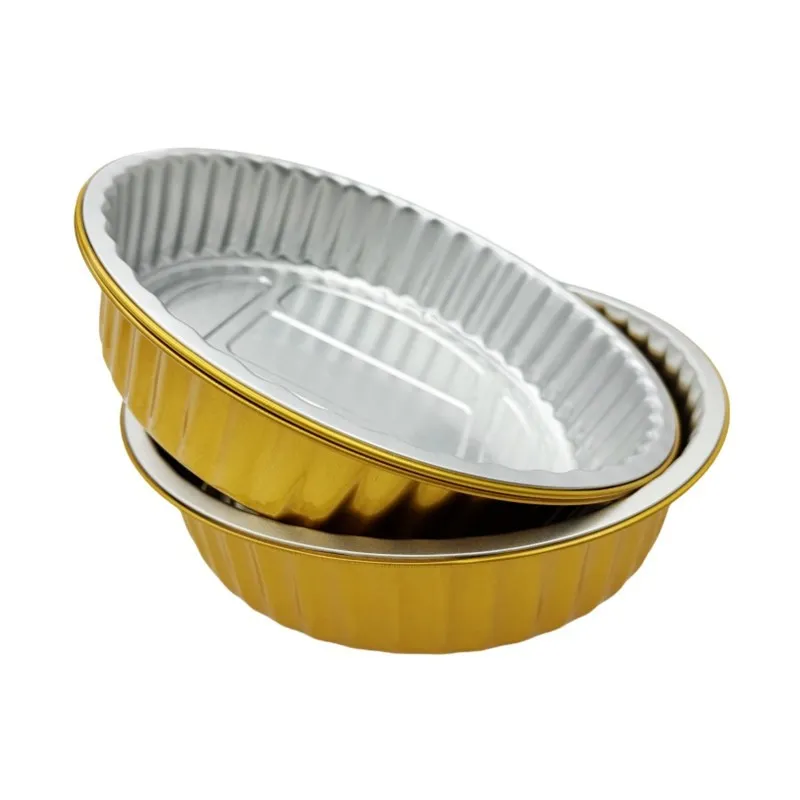
It's also interesting to compare the foil thickness in Aluminum Foil Square Box with that in Aluminum Foil Round Box.
In general, the principles for choosing foil thickness are similar for both types of boxes. However, square boxes might require a slightly thicker foil in some cases. This is because square boxes have corners, which can be stress points. The extra thickness helps to reinforce these corners and prevent them from tearing.
Round boxes, on the other hand, have a more uniform shape, which distributes stress more evenly. So, they can sometimes get away with a slightly thinner foil for the same application.
Why Choose Our Aluminum Foil Square Boxes
As a supplier, we take pride in offering high - quality Aluminum Foil Square Box. We use only the best - grade aluminum foil, and we carefully control the thickness to ensure that our boxes meet the highest standards.
Our boxes are available in a range of foil thicknesses, so you can choose the one that's right for your specific needs. Whether you're a home cook, a restaurant owner, or a food manufacturer, we've got you covered.
We also offer custom - made boxes. If you have specific requirements for foil thickness, size, or design, we can work with you to create the perfect solution.
Conclusion
So, there you have it! The thickness of the aluminum foil used in a square box depends on a variety of factors, including the intended use, product weight, and application. By understanding these factors, you can choose the right foil thickness for your needs.
If you're interested in purchasing Aluminum Foil Square Box or have any questions about foil thickness or our products, don't hesitate to reach out. We're here to help you find the best solution for your food storage and cooking needs. Let's start a conversation and see how we can work together!
References
- "Aluminum Foil Handbook" - Industry publication on aluminum foil properties and applications.
- "Food Packaging Technology" - Textbook on the science of food packaging materials.


